Why Wood Furniture Warps (And How to Make Sure Yours Never Does)
You've seen it. A dining table that was beautiful in the showroom, warped within two years. A top that cupped. A joint that opened. A crack that appeared one winter morning and kept growing.
It's the most common complaint about solid wood furniture, and the most common reason people are afraid to spend serious money on a piece that's supposed to last.
Here's the thing: it's almost entirely preventable. And it comes down to one decision that happens long before the table is built.
Why Wood Warps
Wood is a hygroscopic material — it gains and loses moisture in response to changes in humidity, absorbing and releasing from the surrounding air until it reaches equilibrium. When different parts of a board are at different moisture levels, the wood moves unevenly. It cups. It bows. It checks along the grain.
The industry response is kiln-drying: bringing wood down to a target moisture content before production. For furniture and interior joinery, the standard is 6–8% moisture content — the equilibrium point for wood living indoors in a climate-controlled space. (Source: Oklahoma State University Extension)
A standard kiln cycle achieves this in weeks. And for most furniture on the market, that's where the process ends.
The problem is that weeks of kiln-drying don't fully resolve the internal stresses built up over the decades a tree was alive. The wood is dry — but it hasn't stabilized. Put it in a table, ship it to a home with different humidity than the factory, and those stresses express themselves. Slowly at first. Then, one winter, all at once.
Why Air-Drying Time Is the Variable That Actually Matters
There's a reason old furniture doesn't warp.
The wood used in furniture made fifty or a hundred years ago was typically air-dried for years before it was worked — not because craftsmen were being precious about it, but because that's how long it took before the wood was considered stable enough to use.
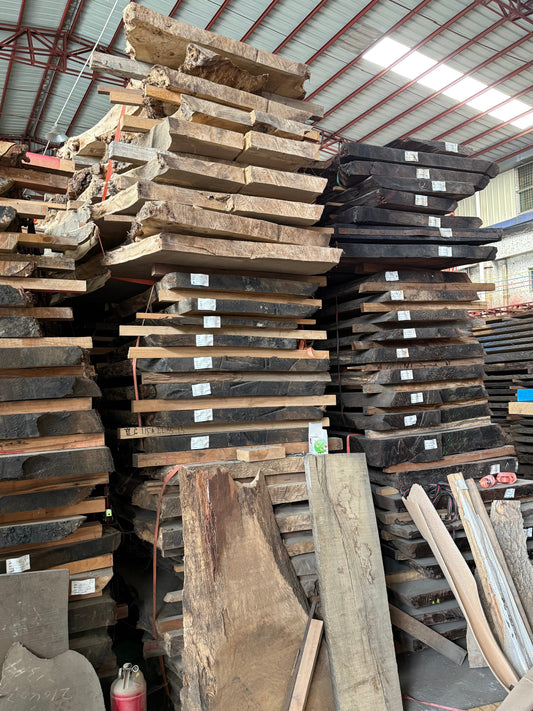
At Monowoodstudio, our black walnut and white oak slabs air-dry for six to eight years after initial kiln processing. The kiln brings moisture down quickly. The years of air-drying that follow let the wood fully equilibrate — let the internal stresses resolve, let the wood settle into what it's going to be.
By the time a slab leaves our workshop as a dining table, it has already done most of the moving it will ever do. It has been sitting, drying, and stabilizing for longer than most mass-market furniture brands have had it in stock.
What to Ask Before You Buy a Solid Wood Table
If you're comparing options, these are the questions that actually reveal quality:
How long was the wood dried? Weeks is the minimum. Years is the answer that matters.
Is it solid wood throughout, or veneer over an engineered core? Veneer looks like wood and behaves like MDF. The movement characteristics are completely different.
What finish does it use? A film-forming finish — polyurethane, lacquer — seals the surface and prevents the wood from breathing. When the wood moves underneath, the film cracks. A penetrating oil moves with the wood.
Where does the wood come from? FSC certification from a recognized body like the Forest Stewardship Council tells you the wood was sourced from a managed, traceable supply chain — not stripped from an unverified source.
What happens if something goes wrong? A brand confident in their work has a clear answer.
The Finish Question
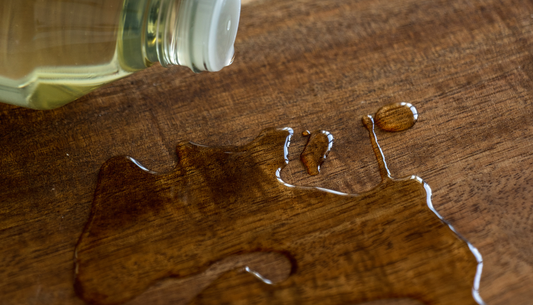
We use Osmo wood wax oil — a German brand established in 1986. It has been independently certified as food-safe and penetrates into the wood, curing within the fibers to create breathable protection that won't crack, peel, or blister. (Source: Osmo Canada)
When you scratch it in five years — and you will, at some point, because this is a table being used daily — you apply Osmo to that spot. You don't refinish the table. No sanding needed. No visible repair line. The finish blends back in.
This is part of why our tables last. Not just the drying time. The finish is also designed for the long term.
What Proper Drying Costs (And Why It's Worth It)
Six to eight years of air-drying is a real cost. It's capital tied up in inventory. It's warehouse space. It's the patience to not rush wood into production before it's ready.
That cost shows up in the price of the table. A properly dried solid wood live edge dining table is not a mass-market purchase.
But the comparison isn't cheap versus expensive. The comparison is one table that outlasts you versus a replacement cycle that repeats every five to seven years — each time with the same result.
The piece that lasts forty years, maintained with an annual application of penetrating oil, costs less over time than the piece that doesn't. And only one of them ends up in a landfill.
The Annual Ritual: How to Maintain a Live Edge Table
One of the most common misconceptions about solid wood furniture: that it demands constant upkeep.
It doesn't. A live edge dining table finished with Osmo needs very little. Once or twice a year — more if the table gets heavy daily use — wipe the surface clean and apply a thin coat of Osmo with a cloth. Let it soak in and dry overnight. That's it.
If a scratch appears, apply Osmo to that specific spot. The penetrating finish blends back into the wood surface; there's no film to patch, no visible repair line.
We include an Osmo care kit with every table delivery. And every six to twelve months afterward, we send a replenishment kit — proactively, without you having to ask. The relationship doesn't end when the table arrives.
Ready to stop replacing furniture?
See our current work or tell us what you're looking for — every piece starts with a conversation.