How to Choose a Live Edge Dining Table: Size, Species, and Leg Style
How to Choose a Live Edge Dining Table: Size, Species, and Leg Style
A live edge dining table is not a purchase you make twice. Which means the decision deserves more than scrolling through options and hoping for the best.
There are three things to get right: size, species, and leg style. Get all three right and the table works for decades. Get one wrong and you'll know it every time you sit down.
Here's how to think through each one.
Start With Size — Room First, Table Second
The most common mistake when buying a dining table is choosing the table before measuring the room.
Interior design guidelines generally recommend a minimum of 36 inches between the table edge and the nearest wall where no one needs to walk behind seated guests, and closer to 44 inches where people regularly pass. Work backwards from that. Measure your dining space, subtract the clearance on all four sides, and what remains is your maximum table footprint.
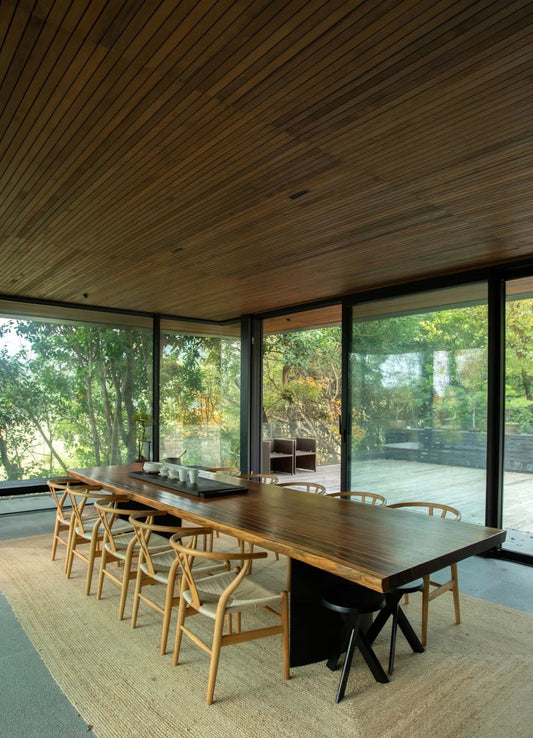
For seating, allow approximately 24 inches of table edge per person — up to 28–30 inches if you want generous elbow room for long dinners. A rough reference for rectangular tables: 6 feet seats 6–8 people comfortably, 8 feet seats 8–10, and 10 feet seats 10–12.
Two things people consistently underestimate: chair width and the difference between daily use and holiday hosting. A table sized for eight at Thanksgiving will feel oversized for two on a Tuesday. Think about who actually sits down most nights, not your maximum guest count.
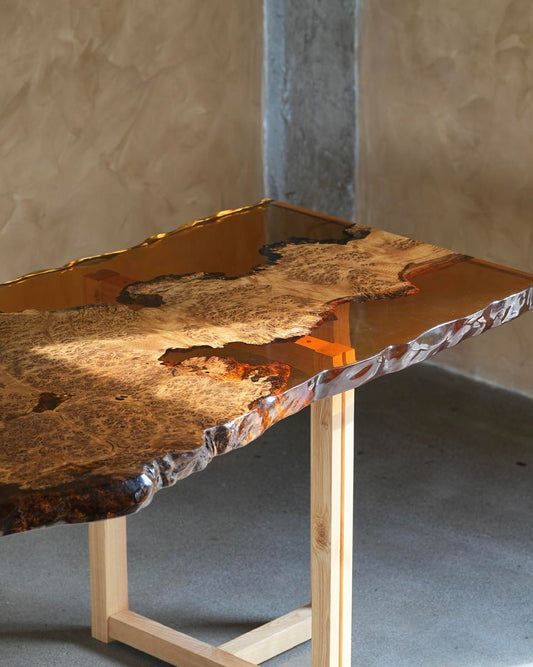
For live edge specifically: a live edge slab has a natural, irregular edge — the width varies along the length of the table. When we give dimensions, we give you the widest and narrowest points. Factor this into your room planning; the table won't be a perfect rectangle.
Species — The Decision That Shapes Everything Else
Once you know your size, species is the next call. It's the decision that determines how the table feels in the room for the next forty years.
The two species we work with primarily are black walnut and white oak. They sit at opposite ends of the visual spectrum.
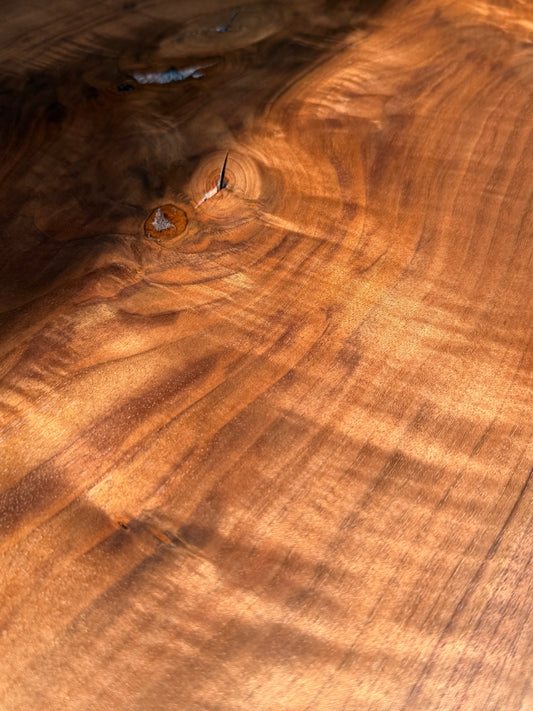
Black walnut is dark — rich chocolate tones, occasionally with purple or green undertones, with a live edge that traces the pale sapwood against the dark heartwood. It anchors a room. It works best in spaces with lighter floors, walls, or furnishings, where it can read as the focal point without competing.
White oak is lighter — pale straw to warm honey, with a distinctive ray fleck pattern that catches light differently depending on the angle. It opens a room up. It's more versatile across a range of interior styles and tends to be the easier choice for open-plan spaces where the table needs to work with a lot of different elements simultaneously.
Hardness: white oak (Janka 1,350) is roughly 35% harder than black walnut (Janka 1,010). For households with young children or heavy daily use, that difference is worth factoring in. For most households, both species are more than durable enough.
For a full comparison of the two species — how they age, how they pair with different interiors, and which is rarer — that's covered here.
Leg Style — The Silhouette Decision
The slab is the table's character. The legs are its silhouette. Get the combination wrong and even a beautiful slab looks off.
Here's how to think through the main options:
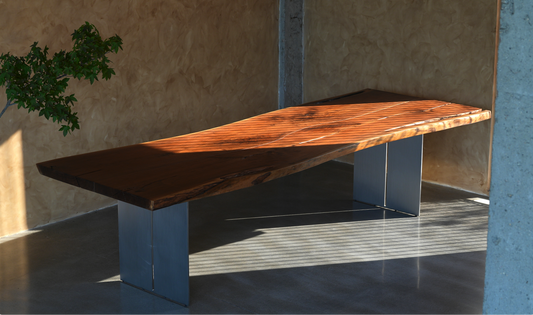
U-frame or T-frame metal legs are the most common pairing for live edge dining tables. A U-frame sits at each end of the table — clean, structural, and visually simple. It lets the slab do the talking. Works in almost any interior style and provides excellent stability for large slabs. This is the default choice for a reason.
Stainless steel legs bring a harder, more contemporary edge. Works well in modern or industrial interiors where the contrast between natural wood and refined metal is the point.
Hairpin legs are slender and minimal — thin steel rods bent into a U-shape, with a small footprint that keeps them visually unobtrusive. They work well in mid-century or Scandinavian interiors. For very large or heavy slabs, a more substantial base provides better long-term stability.
Wood legs are the warmest option — visually continuous with the slab, less contrast, more unified. Works best when you want the table to feel like a single material rather than a combination. Particularly effective with white oak slabs in natural, organic interiors.
Acrylic transparent legs are the most invisible option. The slab appears to float. Effective in smaller spaces where visual weight matters, or in interiors where nothing should compete with the wood itself.
One practical note that applies to all leg styles: make sure there is enough clearance between the table legs and your chairs for people to sit comfortably. A U-frame or T-frame at each end gives the most seating flexibility along the sides and ends. Corner legs can restrict chair placement at the ends of the table.
Custom vs Ready Stock — How the Process Works
Once you've made the three decisions above, the path forward is either ready stock or custom.
Ready stock means a finished slab is available now — you choose from what's currently in the showroom, confirm your leg style and finish tone, and the piece ships. Lead time is shorter than custom.
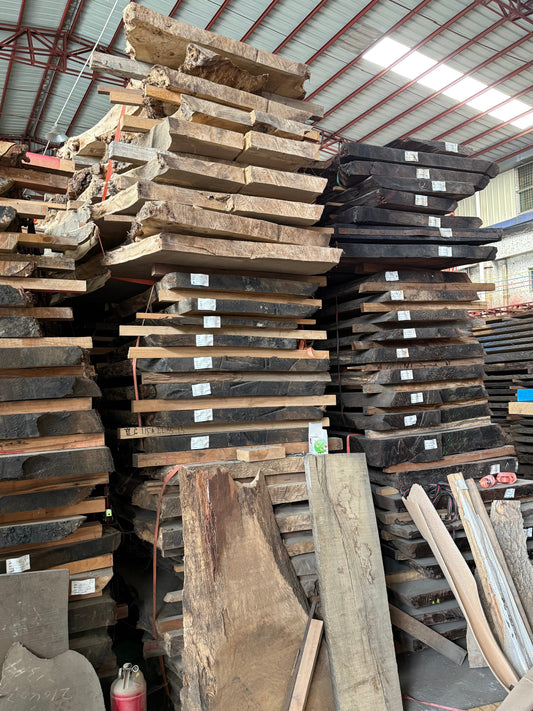
Custom means we source or select a slab to your specifications — species, size, figure — and build to order. Lead time is 8–14 weeks from deposit. This is how most of our tables are made: the buyer has a specific room with specific dimensions, and we work backwards from there.
Neither path is better. Ready stock is right when a piece is available that fits your space. Custom is right when your dimensions or preferences are specific enough that waiting for the right slab is worth it.
The Question We Get Most Often
"Can I see the actual slab before I commit?"
Yes. We share photographs of the specific slab — grain, figure, natural edge profile, dimensions — before anything is confirmed. For custom orders, we share slab options at the selection stage so you're choosing the actual piece, not a representative sample.
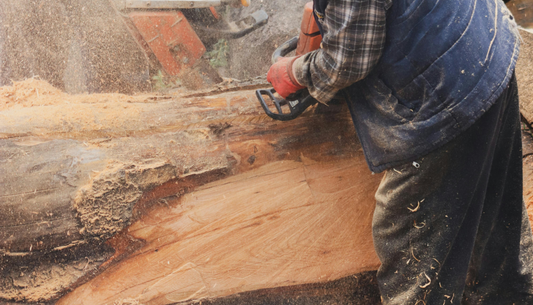
If you're in China or plan to visit, you're welcome to come to our showroom and workshop in Dongguan. Clients who want to see the wood selection, the processing, and the finished pieces in person are always welcome.
Know your size, species, and leg style? See what's currently available or start a conversation about a custom piece.