Black Walnut vs White Oak: Which Is Right for Your Dining Table
以下是更新内链后的完整最终成稿:
Black Walnut vs White Oak: Which Is Right for Your Dining Table
If you've spent any time looking at live edge dining tables, you've almost certainly narrowed it down to two species: black walnut or white oak.
Both are North American hardwoods with centuries of use in fine furniture. Both hold up to daily life. Both get better with age.
But they're not interchangeable. The choice between them shapes how your table looks in the room, how it feels under your hands, and what it will look like ten years from now.
Here's what actually differentiates them.
Color and Appearance
This is the most visible difference, and often the one that decides it.
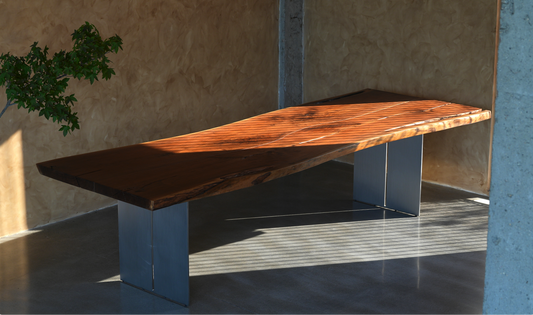
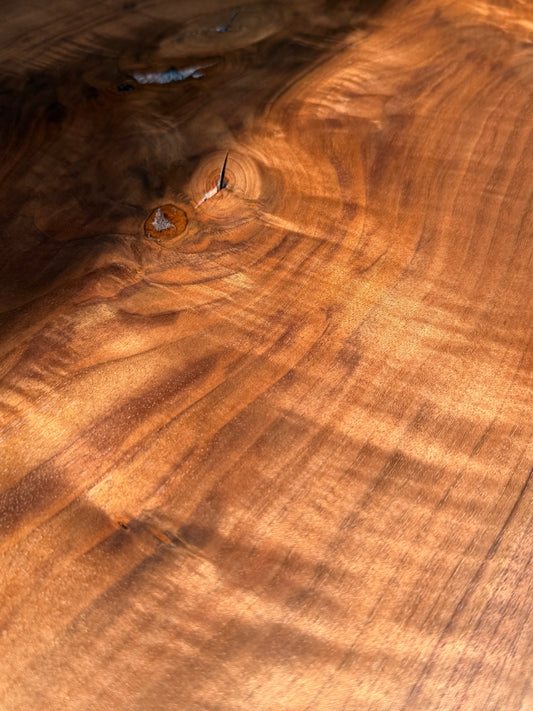
Black walnut is dark. The heartwood ranges from a warm milk-chocolate brown to deep, almost-coffee tones, occasionally with subtle purple or green undertones running through the grain. As the only dark-brown domestic wood species, it has a large following among fine furniture makers and woodworkers. On a live edge slab, the natural edge traces the outer boundary of the tree in a lighter sapwood — that contrast between the pale outer edge and the dark interior is one of the most distinctive visual signatures of a walnut piece.
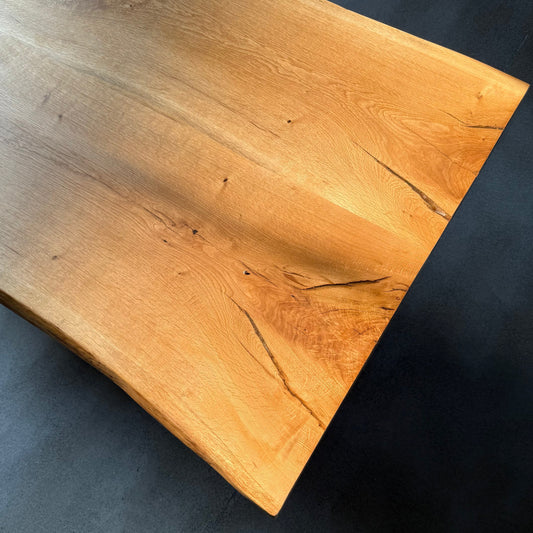
White oak is lighter. The tone typically runs from pale straw to warm honey, with subtle golden or gray undertones depending on how the slab was cut and finished. Where walnut draws the eye inward, oak opens a room up — it reflects light rather than absorbing it.
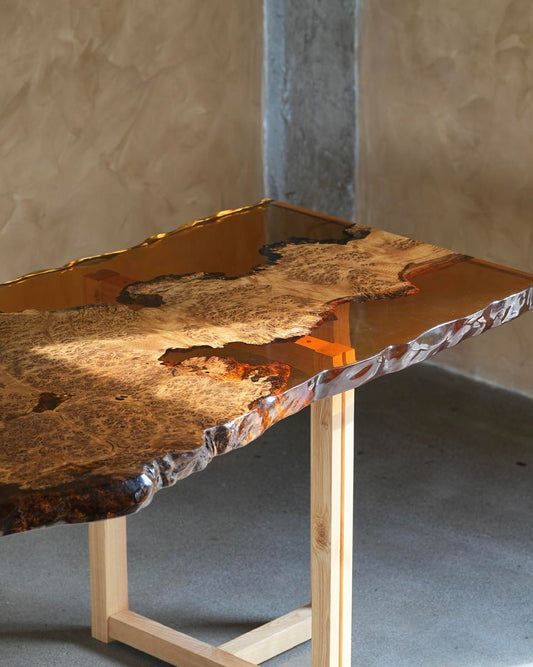
The other defining characteristic of white oak is its ray fleck: especially in quarter-sawn pieces, white oak shows a silky, almost iridescent medullary ray pattern that catches light differently depending on the angle. No two slabs express this the same way. On a live edge dining table, it's one of the most quietly striking details in the room.
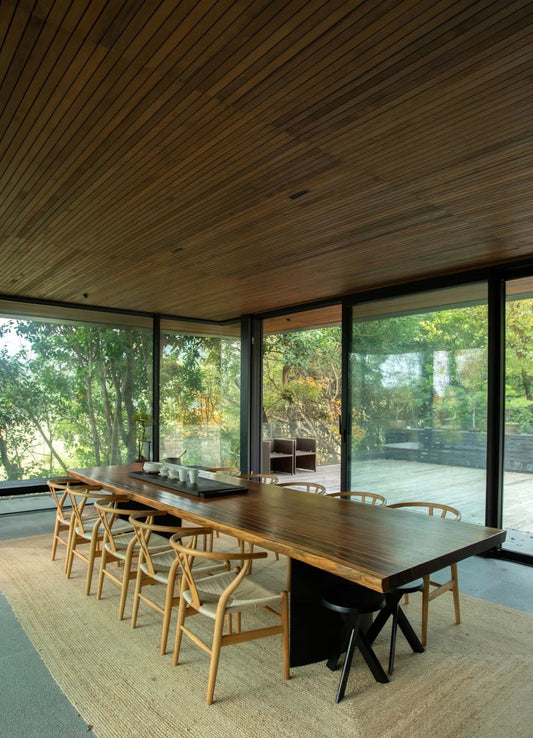
The practical question: What's already in the space? Dark floors, dark cabinetry, or a room that needs anchoring — walnut. Light floors, open spaces, Scandinavian or contemporary interiors — white oak. Neither is wrong. They're just different conversations with the room.
Hardness and Durability
Both species are genuine hardwoods. Both will outlast you with proper care. But there is a measurable difference worth understanding.
White oak scores approximately 1,350 on the Janka hardness scale. Black walnut scores around 1,010 — making oak roughly 35% more resistant to dents and scratches.
In practical terms: walnut is not soft. It handles daily dining life — plates, cutlery, the occasional dropped object — without issue. But in a household with young children, pets, or a table that doubles as a workspace, white oak's additional hardness is a genuine advantage.
For households where the table will be used hard, daily, by multiple people, white oak is the more forgiving choice. For households where the table is treated with intention — a dining table used for meals, not a craft table or homework surface — the difference in hardness matters much less than the difference in appearance.
Either way, the species decision is secondary to one factor that affects both equally: how long the wood was dried before it was built into a table. That's covered here.
How Each Species Ages
Both species develop character over time. But they age in opposite directions.
Black walnut lightens slightly with age and exposure to light. The deep chocolates mellow into warmer, more complex mid-tones. Over the years, natural walnut develops a lustrous patina. The grain, which can appear almost uniform when freshly finished, reveals more depth and movement as the surface builds history.
White oak darkens slightly, the honey tones deepening into richer amber over time. The ray fleck becomes more pronounced rather than less. A white oak table that has been in a family for twenty years looks more interesting than it did on day one — not less.
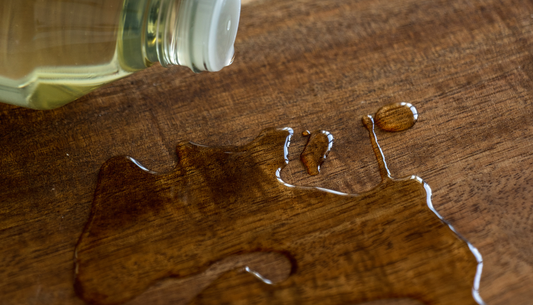
Both species, finished with a penetrating oil like Osmo rather than a film-forming coat, will show this aging naturally and beautifully. A film finish locks the wood's color in place and eventually cracks. An oil finish lets the wood evolve.
Interior Style Pairings
Neither species is restricted to a single aesthetic. But each has a natural home.
Black walnut works well with warm, layered interiors — leather, linen, aged brass. Spaces that already have light elements and need grounding. Mid-century modern and transitional dining rooms. Statement-piece thinking: one dark anchor the room builds around.
White oak works well with contemporary and Scandinavian interiors. Open-plan spaces where light and air matter. Spaces with mixed metal tones — black, brushed nickel, warm brass. Interiors that prioritize calm and cohesion over drama.
Both species pair well with all our leg options — metal U-frame, stainless steel, hairpin, wood, or acrylic. The species choice shapes the feeling of the table. The leg choice shapes its silhouette.
The Question of Rarity
There's one practical difference that affects price and availability.
Black walnut is rarer than white oak. Walnut trees grow more slowly, are less abundant in managed forests, and produce slabs in smaller volumes. A walnut slab of equivalent size and figure to a white oak slab will almost always cost more.
For a custom dining table, this difference is real but not dramatic — it's one input among several that determines the final price. For a buyer weighing two comparable slabs, it's worth knowing that the walnut piece represents a rarer material.
How We Work With Both Species
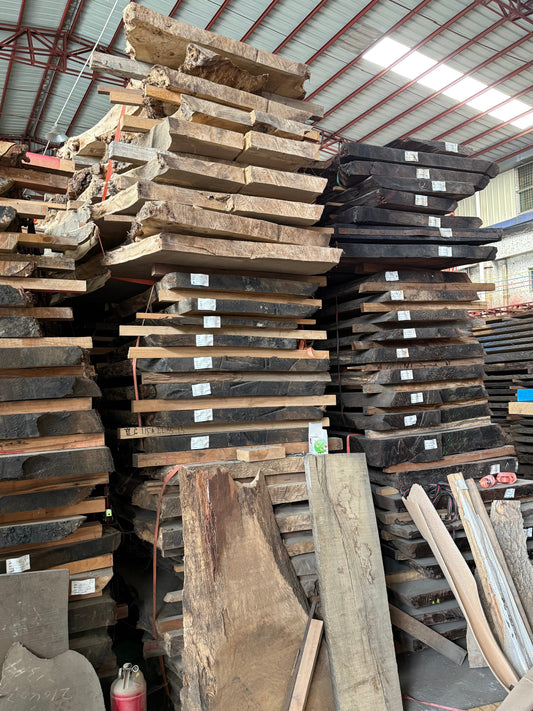
At Monowoodstudio, our black walnut and white oak are both FSC-certified, sourced from North American and European certified suppliers. Both are cut and kiln-dried at origin before coming to our workshop, where they air-dry for a further six to eight years.
The drying standard is identical across both species. The finish — Osmo wood wax oil — is identical. What differs is the material itself: its color, its grain, its character in the room.
We work with both species for custom orders and typically carry slabs in both as ready stock — current availability is shown on our collections page.
Still Not Sure? Here's the Shortcut
If you want drama, depth, and a table that reads as a statement: black walnut.
If you want versatility, light, and a table that adapts as your space evolves: white oak.
If you're still not sure, send us the room. We've placed both species in enough spaces to know fairly quickly which direction makes sense.