Live Edge Conference Table: What Interior Designers Need to Know
Live Edge Conference Table: What Interior Designers Need to Know
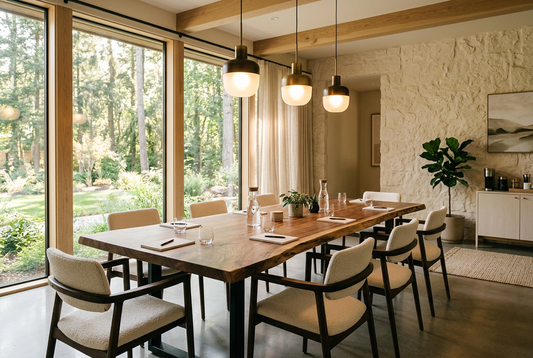
A conference table is not the same project as a dining table.
The specification process is more demanding, the stakeholders are more numerous, the timeline is less forgiving, and the consequences of a mismatch — in size, in lead time, in delivery logistics — are more visible. A dining table that arrives two weeks late inconveniences one family. A conference table that isn't ready for a client's office opening is a different kind of problem.
This post covers what's different about specifying a live edge conference table — dimensions, slab behavior at scale, finish considerations for commercial use, and how the ordering and delivery process works — written specifically for designers who need to get the specification right the first time.
Sizing: The Commercial Standard Is Different From Residential
The residential rule of 24 inches per person doesn't apply in a conference setting where people are working with laptops, documents, and presentation materials.
For conference tables, allow 30–36 inches of table length per person for side seating, with additional space at the ends. Fargo Woodworks For a working session with laptops open, 36 inches is the more comfortable standard. At 30 inches, the table seats more people but feels tight for extended working sessions.
A rough sizing reference for rectangular live edge conference tables:
8 feet — seats 6–8 comfortably for meetings, tight for working sessions with materials 10 feet — seats 8–10, the most common specification for mid-size conference rooms 12 feet — seats 10–12, appropriate for boardrooms and larger client-facing spaces 14 feet and beyond — seats 12–14+, custom slab sourcing required at this length
Standard conference table height is 29–30 inches, aligned with ergonomic standards for standard office chairs at 90-degree arm angle. Tribesigns
On clearance: allow at least 36 inches of clearance around the table for chair movement and circulation. Kaguyasu For a client-facing boardroom where the impression of the space matters, 48 inches feels more appropriate than the minimum.
Slab Behavior at Conference Scale: What Changes
A 10-foot live edge slab is a materially different object from an 84-inch dining table. The length-to-width ratio changes. The variation across the slab — in color, in grain movement, in figure — is more pronounced over a longer span. The natural edge profile, which on a dining table is a design accent, becomes a more dominant element on a 120-inch surface.
A few things to specify carefully at this scale:
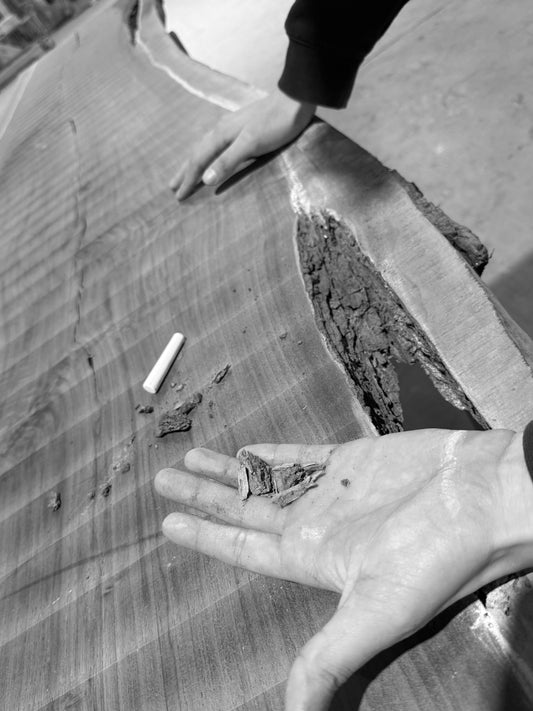
Width variation. A live edge slab is not uniformly wide. On a 10-foot black walnut slab, the difference between the widest and narrowest point might be 6–8 inches. For a conference table, this means one end of the table has meaningfully less surface area than the other. This is a characteristic of the material, not a flaw — but it needs to be designed around. We share exact width measurements at both ends during slab selection so the designer can plan seating and placement accordingly.
Thickness. At conference table scale, 2–2.5 inches finished is the range that reads appropriately in a professional environment. Below 1.75 inches, a long slab can look thin relative to its length — the visual weight doesn't match the scale. More on how to think about thickness here.
Species selection. Black walnut is the most common specification for conference tables. The depth of color and grain reads as serious and considered in a professional context — it projects the same quiet authority that makes it effective as a dining table focal point, but in a boardroom it also communicates something about the organization that chose it. White oak works well in creative studios, architecture firms, and spaces where the design intention is lightness and contemporary restraint rather than gravitas. Full species comparison here.
Finish for Commercial Use
Osmo wood wax oil is our standard finish on all pieces, including conference tables. In a commercial context this requires a direct conversation, because some designers spec film finishes for conference tables on the assumption that a harder surface coating offers better protection.
The case for Osmo in a commercial application: it's food-safe and non-toxic when cured, it's repairable without stripping and refinishing, and it doesn't form a surface film that shows scratches and wear in the way polyurethane does. A conference table with an Osmo finish that gets a scratch or a surface mark can be touched up with a cloth application of oil to that spot. A polyurethane-finished table with a scratch has a visible film break that requires sanding and recoating to address properly.
For clients who use the conference table daily and heavily — which is most commercial clients — the repairability of a penetrating finish is a meaningful practical advantage, not just an aesthetic preference.
Lead Time: Plan Earlier Than You Think
Custom conference table lead time from deposit is 8–14 weeks. At the longer end of that range — a large slab requiring specific sourcing, or a complex leg specification — plan for 14 weeks from deposit to delivery.
For a commercial installation, add the delivery and installation window on top of that. Our DDP service delivers to the North American commercial address included in the price — customs, ocean freight, and last-mile are all handled on our side. What DDP means for the delivery process is covered here.
What this means in practice: if a client's office opening or renovation completion date is a hard deadline, work backwards from that date by at least 16–18 weeks before placing the order. Conference tables that arrive on time to a completed space are unremarkable. Conference tables that arrive after the opening are memorable for the wrong reason.
How We Work With Designers
We quote projects, not items. A designer speccing a conference table alongside a reception desk, a set of benches, or multiple pieces for a commercial installation gets a single project quote — one conversation, one timeline, one point of contact.
Pricing is based on actual sourcing and production cost for each piece. There's no catalogue price. There's no markup applied because the client is a business rather than an individual. We don't operate that way, and designers who work with us more than once know that.
We share slab photographs before anything is confirmed. The designer sees the actual piece — its dimensions, its grain, its edge profile, its figure — and approves it before the deposit is placed. This matters for commercial projects where the client has approval authority over the final specification.
And because we ship DDP to North American addresses — price quoted is price paid, no customs bill at delivery — designers don't have to explain logistics to their clients. The table arrives. The invoice matches the quote. That's the end of it.
The First Project
The most reliable way to understand how we work is to do one project together.
Conference tables are a natural entry point for designers who haven't worked with us before — a single piece, a defined specification, a clear timeline. If the first project goes well, the second conversation is easier. Most of our designer relationships started with one table.
Tell us about the project or see current slab inventory to get a sense of what's available at scale.